There is no reception desk. That single absence changes the entire holiday.
Château St Victor la Coste sits inside a village in the Gard, on the western bank of the Rhône, about half an hour from Avignon. It was built in 1543, it has thick stone walls that were designed against the summer sun and the winter wind, and it is not a hotel. It is a private house that lets rooms, which is a different contract entirely.
Understand the contract and the place makes complete sense. Misread it and you will spend three days waiting for services that were never offered.
The formula, exactly
There are two ways in, and they are not variations of the same thing.
The first is to take one of the three independent cottages, or the suite inside the main building. Each has its own entrance and is entirely private. What they share is a kitchen with a vaulted stone ceiling and flagged floor, a salon on the ground floor, and the gardens and pool. Rented this way, the property holds a maximum of ten guests at a time, which is why it never feels like a small hotel with a busy terrace.
The second is to take everything. The whole château sleeps eighteen in nine double bedrooms with eight ensuite bathrooms, and it includes the cottages, the pool, the gardens and every communal room, among them the grand salon and the pink kitchen. Nothing else is running alongside you.
Some details tell you more than a brochure. Breakfast is homemade and laid out in the communal kitchen in the middle of the morning, for guests to help themselves whenever they wake. Local wines and olive oils sit on an honesty system. There is no air conditioning, because units cannot be fixed to the old external walls, and fans are provided instead.
Three of the cottages have no wifi at all. That is not an oversight. It is the product.
What the building actually is
The house does the things old stone houses do well, and it has been furnished by people with strong opinions rather than a specification sheet.
There are two working kitchens, one built around a Lacanche range with three ovens. The gardens are terraced and planted with old roses, jasmine, lavender and hydrangea, and they climb toward a view of the ruined fortress above the village. The pool is the detail that photographs best and reads oddly on paper: fifteen metres of stone, set among columns and statues, heated, and treated with magnesium rather than harsh chemicals. The water in the house comes from a natural spring on the hillside.
The building is on several levels and the steps are old stone. That is worth knowing before booking for anyone who does not want stairs.
The ruin above the village
Look up from the gardens and you see the reason the village exists.
The lords of Sabran, constables of the Counts of Toulouse, built the citadel known as the Castellas around 1125. It became the stronghold of their territory, the Sabranenque, and Saint-Victor became its capital. Through the twelfth century the population left the plain and rebuilt itself on the northern flank of the hill, under the walls. That is the old village you walk through today.
Then the family chose the losing side of one of the defining conflicts of the French south. In the early thirteenth century Rostand de Sabran tied his fortunes to Raymond of Toulouse against King Louis VIII, in the wars bound up with the Cathars, and lost. In 1249 the fortress was handed to the royal seneschal of Beaucaire, who had its fortifications pulled down on the king’s orders. Saint-Victor became one lordship among many, passing through the Montlaur, Poitiers and other feudal houses.
Royal troops used the site again during the wars of religion, and then it was left alone for centuries. The ruins are a listed monument, the commune now owns them, and a local association has been consolidating the walls and restoring the old village for years. The climb takes about twenty minutes on a steep path, and it is worth doing early. From the top you get the Rhône plain, the Tave valley and the road toward Uzès, which is exactly why the fortress was put there.
A wine appellation that is two years old
Here is the part almost no English-language coverage has caught up with.
Saint-Victor-la-Coste is one of only three communes, with Laudun-l’Ardoise and Tresques, that make up the Laudun appellation. In November 2024 a decree published in the French official journal recognised Laudun as the eighteenth cru of the Côtes du Rhône, ending a campaign that local growers had been running, on and off, since the Forties.
The specifics matter for anyone who drinks seriously. The cru covers roughly 1,150 hectares in the Tave valley. It produces reds and whites only, with no rosé at all, which is unusual this far south. Whites account for close to a third of production, built on Clairette and Grenache blanc with Roussanne and Viognier, and the sandier soils give them a freshness that the southern Rhône is not always credited with. The reds are Grenache noir and Syrah with Mourvèdre. Châteauneuf-du-Pape is about fifteen kilometres away across the river.
So the vines outside the window are not generic countryside. They are a named cru that was promoted the year before last, and the growers are still enjoying it.
What is within an hour
The location is the argument for the whole trip.
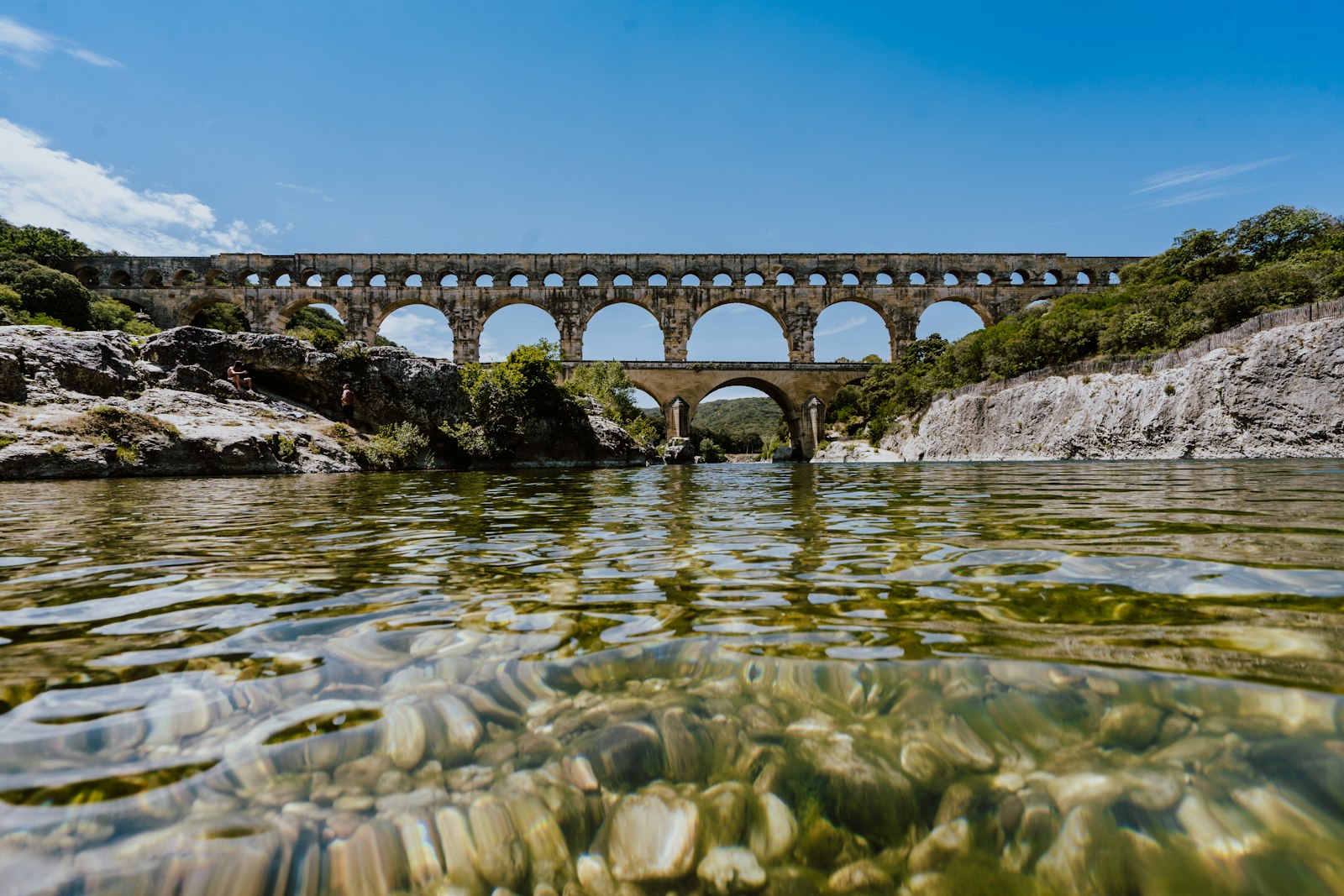
Uzès, the first duchy of France, is a short drive: a stone town of arcaded squares, a Wednesday and Saturday market on the Place aux Herbes, and a Romanesque round bell tower that exists nowhere else in the country. The Pont du Gard, the Roman aqueduct that carried water to Nîmes, is close enough for a morning. Avignon is about half an hour. Châteauneuf-du-Pape is a lunch and a cellar visit. Nîmes and its Roman arena sit an hour south.
None of this is Provence as the market sells it. There is no Luberon traffic and no coastal season, and the difference from the French Riviera two hours east is not subtle. This is the quieter Rhône bank, where the towns work all year and the restaurants are not rehearsing for August.
The trade off
Choose a single cottage and you get the house at a fraction of the commitment, with the gardens, the pool and the stone kitchen included. The trade off is that you are a guest in a shared house. Up to ten people will be moving through the same kitchen and around the same pool, and the rhythm of your day is partly theirs.
Take the whole château and the calculation inverts. Eighteen beds, every room, total exclusivity, a cleaning team on weekday mornings and a chef who can be arranged if booked far enough ahead. The trade off is that you now need the people to fill it, and the discipline to organise a group across nine bedrooms.
The honest test is simple. If your party is two, take a cottage and treat the château as your landlord. If your party is twelve or more, take the whole thing, because half measures in a house like this produce the worst of both arrangements.
Getting there, and when
You need a car, and the owners say so directly.
Nîmes is about an hour by road, Marseille and Montpellier around an hour and a half, Lyon around two and a half. The elegant route is the train: fly to Paris, take the TGV to Avignon, hire a car at the station and drive the last half hour. Hire cars are available at Avignon TGV and at every airport on that list.
On timing, the absence of air conditioning is the deciding factor. Thick stone handles heat well, but late June through August in the Gard is a serious summer, and the house is at its best in May, early June, September and October, when the pool is still heated and the walls are doing their job. A minimum stay applies, and rates improve by the week. Prices are quoted directly by the owners rather than published, which is itself a signal about how the place is run.
Who should take the keys
This is best for people who want a house rather than a service. Families who cook. Groups of friends who want one long table and no timetable. Couples who like a village with a bakery and a bar more than a lobby. Anyone using the Gard as a base for Uzès, the Pont du Gard, Avignon and a serious week of wine.
It is less suited to travellers who want a spa, a restaurant downstairs and someone to carry the bags. That version of the south of France exists in quantity two hours east, on the coast, and it does that job well. This place is doing something else by design: it is lending you a sixteenth-century house in a working wine village and letting you get on with it.
Questions travellers ask
Can you rent the whole château?
Yes. Taken in full it sleeps eighteen guests in nine double bedrooms with eight ensuite bathrooms, and includes the cottages, the pool, the gardens and all the communal rooms for exclusive use. A minimum stay applies and rates are better by the week.
Is Château St Victor la Coste a hotel?
No. It is a private house that rents three independent cottages and one suite, holding a maximum of ten guests when let separately. Guests share a kitchen, a salon, the pool and the gardens. There is no reception and no restaurant, and breakfast is laid out communally each morning.
Do you need a car?
Yes, and the owners advise hiring one. Nîmes airport is about an hour away, Marseille and Montpellier about an hour and a half, and Lyon around two and a half. Avignon TGV station is roughly a thirty minute drive.
Luxury.it perspective
The interesting thing about Château St Victor la Coste is not that it is old or that it is beautiful. Plenty of the French south is both. It is that the place refuses the hotel format entirely, and by doing so it hands the guest something hotels cannot sell: the run of a house, in a village that was the capital of a medieval territory and is now one third of a two-year-old wine cru. Choose it when you want the south of France to be a place you live in for a week rather than a service you consume. That is a narrower proposition than a resort. It is also a much rarer one.
Related guides
Villas & Real Estate · Hôtel Martinez · Luxury Hotels on the French Riviera · Destinations
Looking at the quieter side of the Rhône, from village houses to whole estates? Request a considered view through Luxury.it Concierge.