Capri was not glamorous because famous people went there.
Famous people went there because Capri already knew how to live. That is the detail most retrospectives get backwards. Between the end of the war and the early Seventies, the island did not import a lifestyle from Hollywood or the Riviera. It produced one, out of its own materials: a bay, a fort, a shoemaker’s bench, a pair of trousers, a square the size of a living room.
This is the story of that production, and of how much of it can still be touched in 2026.
The Englishwoman who bought the bay
The golden age has an unlikely founder: a music-hall star from Lancashire.
Gracie Fields, one of Britain’s most famous entertainers of the Thirties, first came to Capri after reading Norman Douglas’s Capri novel “South Wind”, and stayed at an old fort above Marina Piccola. Her own archive records that she bought the property she had first stayed in back in 1933, and the island never let her go: she died at her home on Capri in September 1979.
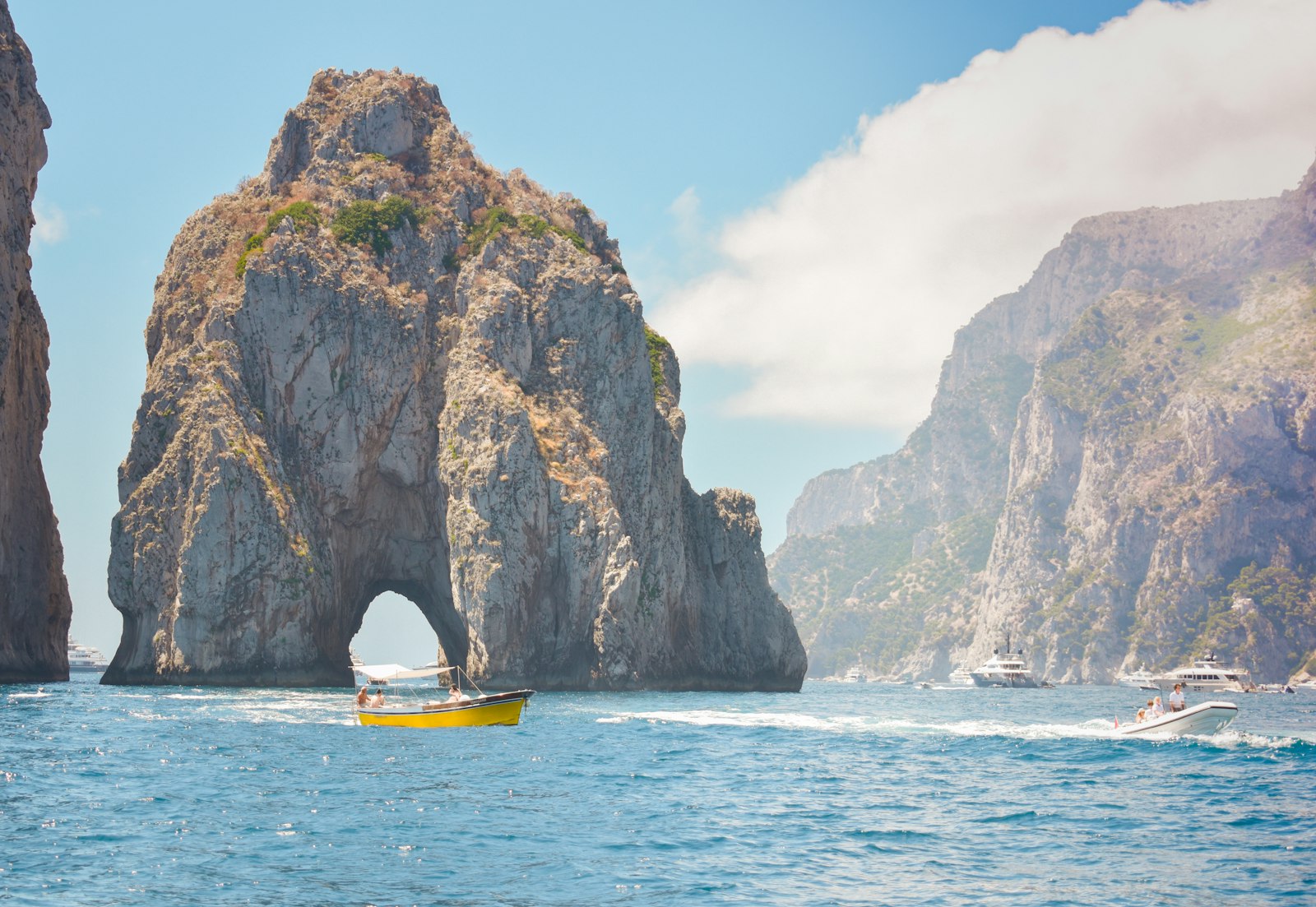
What she built in between changed the south side of the island. On the rocks of Marina Piccola, facing the Faraglioni, Fields created La Canzone del Mare, the lido that turned a fishermen’s bay into the most photographed bathing terrace in the Mediterranean. The pool set into the rock, the terraces in the shade of the Faraglioni, the striped umbrellas: local chronicles describe its terraces in the Fifties as the favourite haunt of the island’s Dolce Vita set.
The important part is that it still exists. The lido operates every summer at Marina Piccola, a short bus ride or the Via Mulo walk down from the Piazzetta, and in high season it remains one of the hardest reservations on the island.
A sandal shop opposite the Quisisana
The second founder worked leather, not terraces.
In 1946, Amedeo Canfora opened a small handmade-sandal shop on Via Camerelle, directly opposite the Grand Hotel Quisisana. The timing was perfect: postwar Capri was becoming the port of call of the international set, and Canfora‘s made-to-measure sandals found their way onto the feet of Princess Margaret, Grace Kelly and Maria Callas.
Then came the night that made the shop a legend. In 1962, Jacqueline Kennedy, visiting the island as First Lady, asked for the boutique to be opened for her at midnight so she could choose in peace. The Canfora family has said it was the only time the shop ever opened at that hour. She ordered several pairs, and Amedeo designed a model especially for her, the K, a triangle of interlocking rings that is still made and sold in the same shop today, cut and sewn by hand by the family.
Few luxury souvenirs anywhere in Europe carry this much verifiable history. You can walk into the same room on Via Camerelle, have your foot measured, and leave with the sandal a First Lady ordered at midnight.
Trousers named after an island
Capri is one of the few places on earth to have a garment named after it, and the story is more precise than the legend.
The cut is usually credited to the designer Sonja de Lennart, who named her postwar collection after the island and, in the late Forties, produced the slim, cropped trouser with its small side slit that became known as the capri pant. Italian designers, Emilio Pucci among them, made it the uniform of the island summer in the Fifties, and the cinema did the rest: once Audrey Hepburn wore the cut, the island’s name was sewn into wardrobes on both sides of the Atlantic.
That is the pattern of the whole era. Capri did not chase fashion. Fashion kept finding reasons to name itself after Capri.
The island did not chase the world. The world kept arriving, and Capri simply continued its day.
The stage and the writers
Every golden age needs a stage, and Capri’s is famously small.
The Piazzetta, officially Piazza Umberto I, is barely larger than a private courtyard, which is exactly why Italians came to call it the drawing room of the world. In the Fifties and Sixties its four cafés were where the island’s evenings began and ended: the walk from the funicular, the first aperitivo, the last conversation before the lanes went dark.
Behind the scene stood the writers who had built the island’s myth in the first place. Norman Douglas, whose “South Wind” had drawn Gracie Fields and a generation of northern romantics, lived out his last years on the island. Curzio Malaparte left the era its strangest monument: Casa Malaparte, the red house on Punta Massullo, begun in the late Thirties, which later entered cinema history as the set of Godard’s “Le Mépris”. The house remains private, visible only from the sea, which feels correct. Some of the golden age is meant to stay at a distance.
What remains, and how to find it
The honest answer: more than you would expect, if you time it properly.
The Canzone del Mare still opens its terraces at Marina Piccola each season; in July and August, book weeks ahead, and expect the premium bracket, with entry and a lounger able to pass fifty euro per person at peak. Canfora still measures feet on Via Camerelle. The Piazzetta still performs its evening ritual once the day boats have left. Marina Piccola is a short ride from the Piazzetta, with buses roughly every quarter of an hour, or a fifteen-minute walk down.
Timing is the entire game. The golden-age island appears early in the morning and after seven in the evening, in May, June and September more than in the crowded core of summer. Sleep on the island rather than day-tripping, and the Fifties rhythm returns almost mechanically: sea in the morning, lunch in the shade, the square at dusk. Even the island’s newest addresses understand this: the hotels opening on Capri now are built around rooftops, salons and slow hours rather than spectacle, a private-club reading of exactly the era this article describes.
Questions travellers ask
Is La Canzone del Mare still open?
Yes. The lido founded by Gracie Fields still operates every summer season at Marina Piccola, with pools, terraces and a restaurant facing the Faraglioni. In July and August, reserve well in advance.
Can you still buy the sandals Jackie Kennedy ordered?
Yes. Canfora still operates on Via Camerelle, and the K model designed for Jacqueline Kennedy in 1962 is still handmade to measure in the shop, alongside the rest of the historic styles.
When is the best time to feel the old Capri?
Late May, June and September, and always early morning or evening. The island between eight at night and ten in the morning still belongs to the people staying on it, which is the closest thing to time travel Capri offers.
Luxury.it perspective
Capri’s golden age matters because it was built, not booked. A singer bought a bay and gave it a stage. A craftsman opened a shop and dressed the century’s most photographed feet. A designer named a trouser after the island and the island kept the name. None of this was a marketing plan, which is precisely why it lasted. The traveller who wants that Capri in 2026 does not need a time machine. They need a reservation at Marina Piccola, twenty minutes at a sandal-maker’s bench, and the discipline to be in the Piazzetta after the last ferry has gone.
Related guides
Il Capri Hotel · Mediterranean Yacht Charter · Luxury Openings · Destinations
Planning Capri around its history rather than its crowds? Request access through Luxury.it Concierge.