On a 43.6-metre yacht, the same two people drew the interiors and one deck chair. RODA’s Vela armchair, by m2atelier, went to sea for the first time this month aboard Azimut’s Grande 44M at the Cannes Yachting Festival. Azimut credits the same studio with the yacht’s interiors.
A chair is an odd thing to notice on a four-deck yacht. It is worth noticing here because of who drew it, and because the usual order of events, in which a decorator finishes the saloon and somebody else later fills the deck with furniture, has been skipped.
One studio, two scales
RODA’s announcement of 14 September names Marco Bonelli and Marijana Radovic, the founders of m2 atelier, as Vela’s designers. The chair was shown at Milan in April and has now, in RODA’s words, “entered the world of yachting for the first time”. The two companies are not new to each other: RODA furniture has appeared at previous Cannes editions on Azimut’s terrace, its dock and one of its yachts.
The credit block is unambiguous. Exterior designer, Alberto Mancini. Interior designer, M2ATELIER. Which makes this more than another brand name on a specification sheet: somebody who drew the rooms also drew a seat, and could think about how you approach it, what it faces and what stays visible behind it.
No yacht needs every object by one hand.
It does suggest a discipline worth keeping: the chair should work in the room before anybody looks at the label.
What Vela is made of
RODA’s Milan description is precise: “The natural iroko wood structure supports a painted aluminum backrest with woven straps. The cushions enhance comfort without altering the purity of the design, while the padded armrests add both tactile and visual softness.” Two lounge-chair configurations, one for reclining and one for conversation.
Iroko, then. Everything wooden on a deck gets called teak by reflex, and since RODA sells a separate teak line under the name Teka, the distinction is a real one rather than a pedantic one worth correcting in a caption.
Keeping frame, straps and cushion separate also changes what the chair does to a deck. You can still see through it and around it, which a fully upholstered outdoor sofa does not allow. That is a way to furnish a view without building a padded wall across it.
Choose the configuration by posture. A deeply reclined chair is perfect alone with a book at four in the afternoon and useless at seven, when its occupant is supposed to be leaning forward with a glass in hand and can only lie back looking at the sky.
The yacht around the furniture
| Element | Builder’s specification |
|---|---|
| Length overall | 43.6 metres |
| Maximum beam | 8.67 metres |
| Deck arrangement | Four decks, where the class usually has three |
| Guests and crew | 10 berths in 5 or 6 cabins; 9 crew in 5 |
| Engines | 2 x MAN 1550 hp, with 1800 hp optional |
| Speed | 17 knots maximum, 15 cruising |
| Exterior design | Alberto Mancini |
| Interior design | m2atelier |
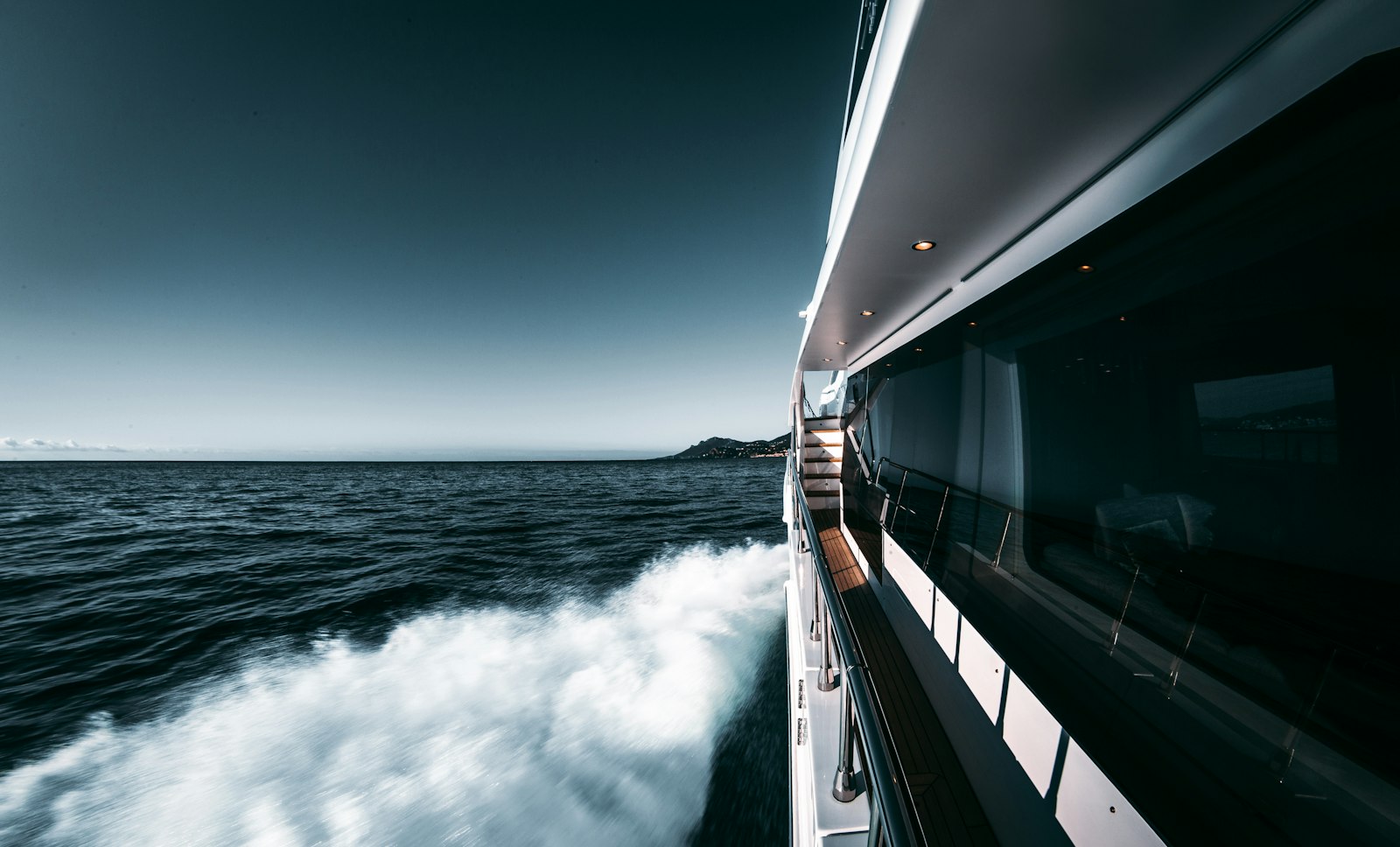
Azimut’s own phrasing about the top level is careful: the upper deck “can be converted into an owner’s deck with barrier-free sea views both forward and astern”. Converted, note, rather than built that way. What interests us here is less the cabins than what four decks ask of the outdoor rooms between them.
A terrace for one person at seven in the morning should not be furnished like the deck where ten people meet at seven in the evening, and repeating one seating arrangement on every level throws away the whole advantage of that fourth deck. Two chairs and a small table often beat another long sofa.
Leave somewhere to go.
So the question is never how to fill a deck. It is which parts should feel occupied, which should stay empty, and how somebody crosses between them without interrupting anyone.
Read the installation before reading it as a specification
The Italian coverage of 16 September records Vela aboard the yacht and nothing more. No source says the chair is standard on a Grande 44M, no price appears anywhere, and nobody describes a marine-specific version. RODA does not yet list Vela among the 59 collections on its own site.
An owner commissioning one should therefore ask which pieces and finishes sit inside the quoted package. A designer borrowing the idea for another hull should separate how the chair looks from how it is secured underway, where it goes in a blow and who cleans the straps.
Those belong with the technical team.
A good boat-show installation proves a taste. It does not prove a specification.
A useful detail to follow through the yacht
This is a useful way to read any interior project. Start from an object small enough to understand completely, then look outward at the architecture holding it.
On the Grande 44M, chair and interior share an author. That much is documented. Whether shared authorship makes the spaces feel related rather than merely repetitive is a judgement nobody can make from a photograph.
The answer arrives in use. A comfortable position, a clear passage past it, somewhere to put the glass down, and a view the furniture has not eaten. Four things. A good terrace finds room for all of them.
The Luxury.it perspective
Shared authorship across scales is rarer at sea than on land, and the reason is commercial. Outdoor furniture on a yacht is usually chosen late, by a different party, from a catalogue, because it is one of the few things that can still be changed when everything structural has been decided. Doing it the other way round takes organisation nobody gets credit for.
We would not oversell it. One chair by the interior designer does not make a coherent yacht, and the Grande 44M has three other decks to prove the point on. But it is a small sign of a project where somebody thought about the sequence.
The detail we like best is the iroko. It would have been easier, and better for the brochure, to say teak.
Related guides
Our report on Quagliotti’s work with Ferretti Yachts looks at the same question from inside a cabin.