Benetti has sold the first B.Neos 40M, named The Soul of Silence, for delivery in spring 2028. The owner’s apartment takes the forward half of the upper deck, which is the headline. The more revealing decision sits one deck below, where the traditional dining room has been deleted and a kitchen put in its place.
The buyer was represented by Royal Yacht International, through its chief executive Manuele Thiella, and nothing else about them has been disclosed. The numbers are settled: 40.63 metres overall, 8.66 of beam, 296 gross tonnes, ten guests in five cabins and seven crew in four. What is not settled is how any of it feels, because the yacht does not exist yet.
For anyone looking at forty metres, the interest is in how the volume has been spent. Privacy upstairs, shared life downstairs, hybrid machinery underneath. Benetti has written those three as one brief.
The private terrace is forward; the aft deck is a choice
Owner’s Apartment is Benetti’s own term, and it takes the whole forward half of the upper deck. “Introduced by a dedicated lobby, the suite opens to the sea,” the yard writes, with sliding doors onto a personal terrace behind a glass balustrade. Then, aft, a second terrace that Benetti describes as an outdoor retreat one deck up, “private or shared”.
Those three words, private or shared, deserve more thought than the phrase owner’s deck. A couple wanting breakfast outdoors without crossing guest territory will close the aft terrace off. A family will open it and keep only the bedroom and the forward deck to itself.
Trace those movements on the plan before anybody picks finishes. Guests should reach the shared deck without passing a private door, service should arrive from somewhere sensible, and the owner should get back from the water without a tour of the guest cabins. Privacy that depends on a stewardess explaining an invisible line is not privacy.
The family kitchen changes the formality downstairs
Benetti’s own sentence is the clearest statement of intent on the whole boat: “the traditional dining room evolves into a generous open-plan Family Kitchen, directly connected to the galley”, and it can be “easily closed off by a discreet glass partition when desired”. One clarification, since the phrasing invites confusion. There is still a dining table aboard, set athwartships. What has gone is the separate room around it.
For plenty of owners that is the better room. It lets a household assemble in pieces: coffee for one person at seven, breakfast for another at ten, a word with the chef that does not involve walking into a working galley.
It also creates questions for the design table. Extraction and noise, first. Then where a stewardess puts a tray down, and whether a child can sit at that counter while service carries on around them. Informality at sea is the product of very careful engineering.
A low profile, with a social room near the water
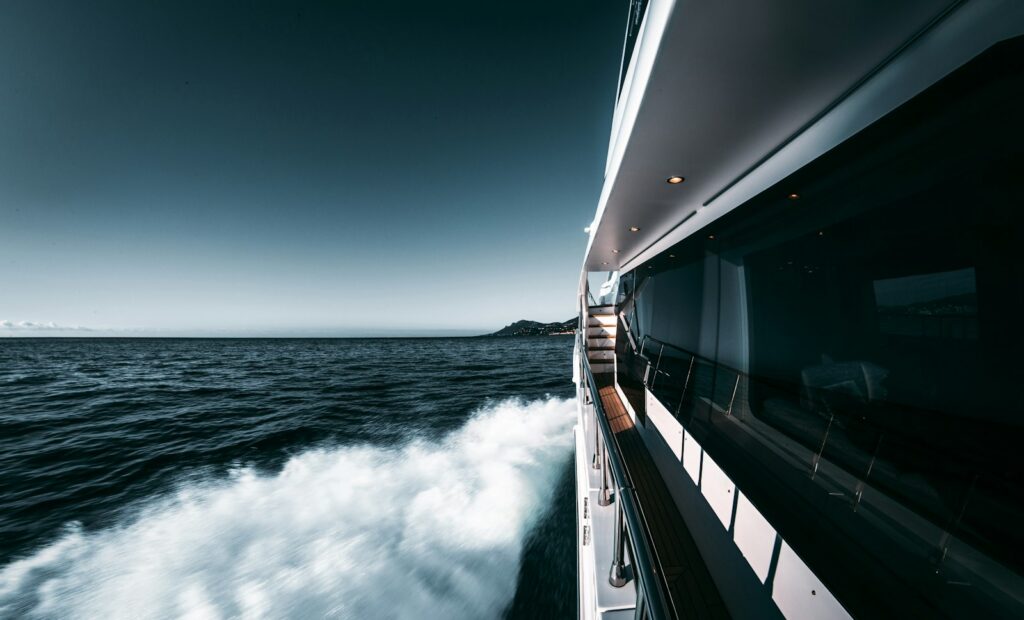
Malcolm McKeon Yacht Design drew the exterior and the concept, working with proportions borrowed from sailing yachts. Glass, low lines, repeated timber. It reads differently from a motor yacht designed to look as tall as its tonnage allows.
Inside, Francesca Muzio’s FM Architettura took the interiors and deck design, describing “a sequence of interconnected spaces rather than formal compartments”. Both studio and yard use the name Sea Atrium for the volume aft: 2.4 metres high, framed in full-height glass, joining the pool terrace to the interior so the space nearest the water is somewhere to sit rather than a corridor to the swim platform.
Our reading is that this plan suits an owner who spends long stretches aboard with the same small group. Most of the day happens without changing rooms or changing clothes.
An owner hosting different guests every night will want more separation than this. Neither plan is better. The question is whether the yacht should behave like a summer house or like a series of reception rooms.
Hybrid is a set of operating choices
The machinery is MAN Smart Hybrid, with two 200 kW electric motors alongside the diesels. MAN’s own announcement describes battery-electric running, where “local emissions can be almost completely avoided when cruising or anchoring”, and a cross-over mode matching engines, generator and motors. Worth noting: MAN names the engines as V8-900 units of 662 kW, while Benetti’s own release calls them V8-800. Ask which is in the contract.
MAN adds the qualification that matters most, and it is easy to read past: hotel operation runs “for many hours depending on the installed battery capacity”. Silent at anchor is therefore not a number of hours. It is whatever your air conditioning, lighting and refrigeration leave of the battery you chose to buy.
Both Benetti and MMYD publish the same range, 2,600 nautical miles at ten knots. That is a model figure for the yacht as a whole, and nobody is suggesting it can be covered on batteries. Sea trials in 2028 will produce the real one.
So put a real day to the yard instead of a mode list. A night at anchor with all five cabins full, breakfast for ten, a morning swimming, an afternoon departure. Ask how much of that the agreed battery supports, at what point a generator has to start, and how it recharges. Far easier to judge than a promise of silence.
Read the renders as decisions still being made
The first useful documents are the specification and the general arrangement. Private or shared deck space, the kitchen’s relationship to service, the size of the battery: none of those can be corrected later with upholstery.
Everything published so far is project material, showing intentions rather than sound levels, air movement or comfort in a seaway. Spring 2028 will let somebody compare the two.
Until then it earns attention because its main ideas map onto actual life aboard. Close the bedroom door, eat breakfast without ceremony, decide each morning how much of the day to share.
The Luxury.it perspective
Deleting the dining room is the bravest thing on this boat, and the easiest to get wrong. A formal dining room is dead space that justifies itself perhaps twenty evenings a year; a family kitchen is used every single morning. Benetti has bet that owners now want the second, and we think the bet is right.
The hybrid deserves more scepticism, though not because the technology is doubtful. MAN itself says hotel running depends on installed battery capacity, which means the silence an owner experiences is a line item they negotiate, not a property of the model. Two identical B.Neos hulls can be very differently quiet.
One small thing we would want cleared up before signing. The yard and the engine maker are publishing different engine designations for the same yacht. Not important in itself. Very useful as a test of how quickly the project team answers an awkward question.
Related guides
Our Yachts & Aviation edit follows the wider market.