Italy has nine hotels in the 51 to 100 section of The World’s 50 Best Hotels 2026, more than any other country in Europe.
Five of them are in the ranking for the first time: Il San Pietro di Positano, Castiglion del Bosco, Orient Express La Minerva, Forestis and Villa Treville. Four return: Splendido, Borgo Santandrea, Borgo Egnazia and Reschio.
The top 50 is announced in Paris on 15 September, at Les Salles du Carrousel. So the Italian total for the full hundred is not yet known, and it can only go up.
The nine, in order
- No. 58, Il San Pietro di Positano. New entry, and the highest-placed Italian hotel in this half of the list.
- No. 60, Splendido. Portofino, back in after its renovation.
- No. 62, Castiglion del Bosco. New entry, Montalcino. The estate side of Tuscan hospitality.
- No. 66, Orient Express La Minerva. New entry, a Roman palace a minute from the Pantheon.
- No. 68, Forestis. New entry, above Brixen in South Tyrol.
- No. 84, Borgo Santandrea. Amalfi, returning.
- No. 88, Borgo Egnazia. Savelletri, in Puglia.
- No. 91, Villa Treville. New entry, Positano, Franco Zeffirelli’s old house.
- No. 95, Reschio. Lisciano Niccone, Umbria.
Europe has 16 hotels in this section. Italy takes nine, France four, the United Kingdom two, Turkiye one.
Five new entries, five different ideas of a hotel
What stands out is that the Italian result is not one formula repeated.
Il San Pietro and Villa Treville are small coastal houses whose value comes from land nobody could build on today, private access to the water and a physical relationship with Positano that cannot be reproduced elsewhere on the coast.
Castiglion del Bosco is an estate in which the hotel is one part of a working agricultural and residential landscape.
Orient Express La Minerva is a different market entirely: an internationally branded conversion in the centre of Rome, using a recognised name and a rooftop to establish the first fixed address of a travel brand that spent its life on rails.
Forestis is altitude. Roughly 1,800 metres above sea level, above Brixen, with the Dolomites doing the organising rather than the interior designer.
Read together, the five point at assets that take generations to assemble. Coastal land. Protected architecture. A working estate. A mountain. A building with a cultural history of its own.
Three of the nine are on the Amalfi Coast
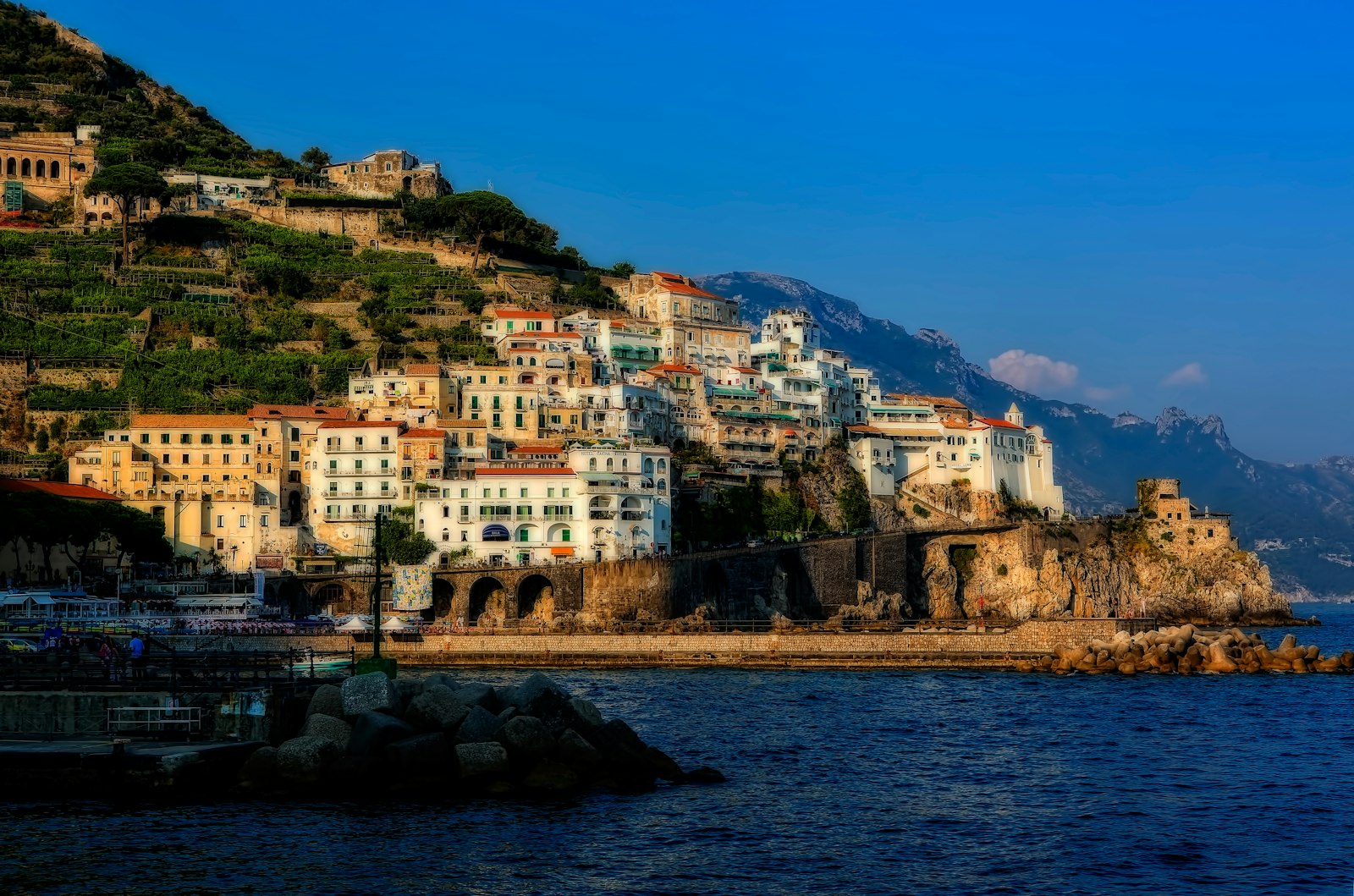
Il San Pietro, Borgo Santandrea and Villa Treville sit between No. 58 and No. 91, all on the same forty kilometres of cliff.
That density is commercially unusual. The coast has almost no room left for large new luxury development, and it keeps generating international demand anyway, through a small number of highly individual properties that cannot be scaled.
They are not interchangeable. Il San Pietro is cut into the rock outside Positano, with a lift down to its own beach and boat landing. Villa Treville is a set of separate villas around Zeffirelli’s former residence. Borgo Santandrea is further along, closer to Amalfi and Conca dei Marini, with a different arrival and a different rhythm to the day.
One caution about reading the coast through the ranking. A hotel controls its rooms, its service and its own water. It does not control the road above it in August, the ferry timetable or the crowd on the steps in Positano. Those remain part of the week, and they are the part travellers most often underestimate.
Anyone comparing the three should start from our guide to luxury hotels on the Amalfi Coast and choose on access and geography before position. For the tables between them, Holiday.it has gone through the restaurants of the coast town by town.
Rome arrives through a new hotel
Orient Express La Minerva at No. 66 is the entry that says most about how fast a well-placed opening can travel.
The hotel occupies a 17th-century building beside the Pantheon, keeping the historic architecture and adding a rooftop pool and a contemporary programme underneath it.
It also shows what happens when a globally recognised name meets an address that cannot be copied. The brand brings the first wave of attention. The building and the piazza are what keep it.
Worth holding in mind: a first appearance in the list records the strength of the stays that voters submitted, not years of proven consistency. Voters may include hotels visited at any point in the eligible window, recent openings included.
How the vote actually works
The ranking comes from more than 800 members of an international Academy, split across 13 regions, with at least a quarter of the panel replaced each year.
Each voter names seven hotels in order. Each must have stayed at least one night in the previous 36 months, and must give the date of the stay.
There is no scorecard. Voters are not asked to rate service, architecture, rooms, food, spa, privacy, value or consistency against a shared standard. Every one of them decides privately what best means.
Press trips, complimentary stays and nights taken on loyalty points all count. Voters cannot vote for a hotel or group they work for, own, advise or hold an interest in, and no more than three of their seven can come from the same group.
Deloitte holds the voting data as independent adjudicator and runs procedures intended to verify the integrity of the process.
What that measures, and what it does not
It measures accumulated preference among a large group of people who travel constantly and stay everywhere. That is closer to an international consensus than to an inspection programme, and it is genuinely useful: sustained support across many voters is hard to manufacture.
It also rewards visibility. A twelve-room house on a cliff can be seen by fewer eligible voters in three years than a hotel with a global sales network and a busy press office. That is arithmetic, not a criticism of either.
Which is why the number itself deserves less weight than the name beside it. A hotel at No. 95 may be the right answer for a particular family, route or week; one at No. 55 may not. The list is a good shortlist and a poor tie-breaker.
Reading the nine by the trip they suit
- The coast: Il San Pietro, Villa Treville, Borgo Santandrea.
- A city stay: Orient Express La Minerva.
- Estates: Castiglion del Bosco, Reschio.
- Mountains and wellness: Forestis.
- Established resorts: Splendido, Borgo Egnazia.
Grouped this way the list becomes usable. Three nights in Rome, a week above Positano and a February in the Dolomites are not competing propositions and never were.
One practical consequence. Several of these hotels have small room counts and short seasons, and recognition of this kind moves the good dates first. Anyone with a 2027 idea involving Positano or Forestis should be having that conversation now.
What changes on 15 September
Everything above covers positions 51 to 100 only. The top 50 lands on 15 September in Paris, and with it the country’s real total and its highest-placed hotel.
Italy has had strong showings in the top 50 in recent years, so the nine announced so far is a floor and not a ceiling. We will add the new names to this page when they are published.
Luxury.it perspective
What makes the Italian nine convincing is how little they have in common.
A cliff outside Positano, a Roman palace, a Tuscan estate, a mountain above Brixen, a Umbrian farm rebuilt over twenty years. None of it can be assembled quickly, and none of it can be repeated in another country by spending more money.
The list remains a vote and not an audit. Its value is in showing where experienced travellers keep returning. The work that matters starts after that, in deciding which of those nine has the location, the access and the character for the particular week in front of you.
Related guides
Continue through the Hotels desk, the guide to luxury hotels on the Amalfi Coast and the latest arrivals in Luxury Openings.
For difficult reservations, private transfers and multi-property Italian itineraries, contact Luxury.it Concierge.