The Vasari Corridor is open every Friday evening until 20 November, from seven until eleven, with timed entries running to 9.50pm.
An advance ticket is 24 euro. A same-day one, if a slot is left, is 20. There is a reduced rate at 2 euro for those who qualify.
And then the line that catches people out: the ticket covers the corridor and nothing else. You walk through part of the Uffizi to reach it, and you are not allowed to stop.
Which makes this its own thing entirely. It is not a cheap way into the gallery.
Corridor only, and they mean it
The ticket is called Vasari Corridor, Special Opening. Booking is compulsory for everyone, and places depend on what is left in each slot.
Entries go at 7pm, 7.20, 7.40, 8, 8.20, 8.40, 9, 9.20 and 9.50. Groups are capped at 25 people, and that 25 includes private guides and carers.
Do not confuse it with the daytime combination. That one costs 43 euro on the day or 47 in advance and lets you into the Uffizi two hours before your corridor slot.
The evening version is cheaper because the gallery is not in it. If you want Botticelli, Leonardo and Caravaggio, that is a separate ticket on a separate visit, and it should be booked as such.
You start by the Loggia dei Lanzi and you finish across the river
The meeting point is the entrance in Piazzale degli Uffizi, beside the Loggia dei Lanzi. From there the group crosses designated parts of the Uffizi and enters the raised corridor.
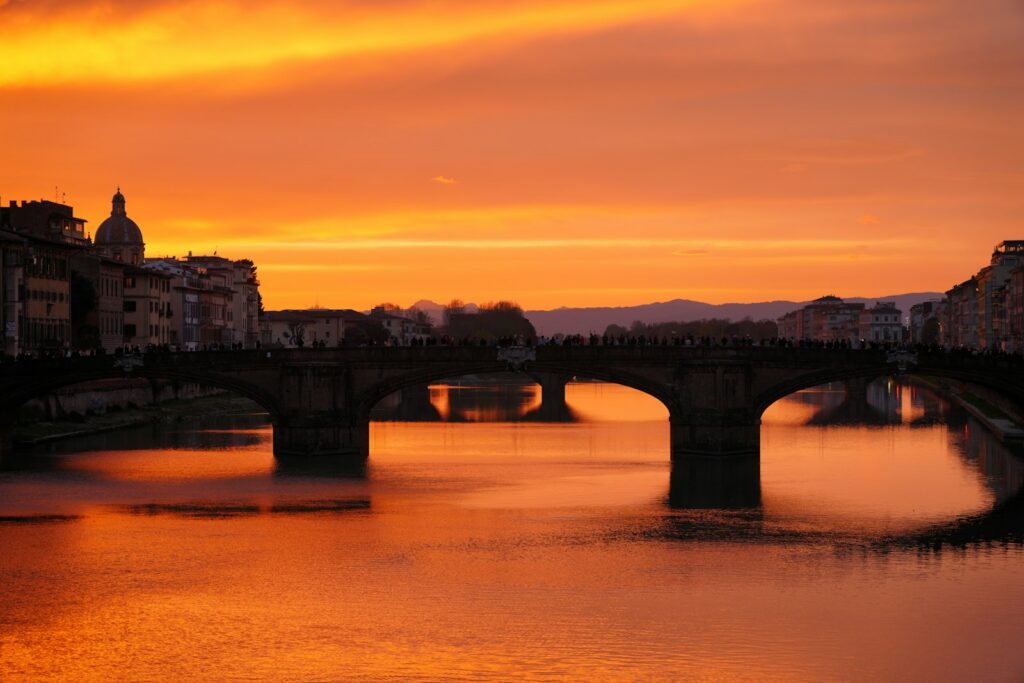
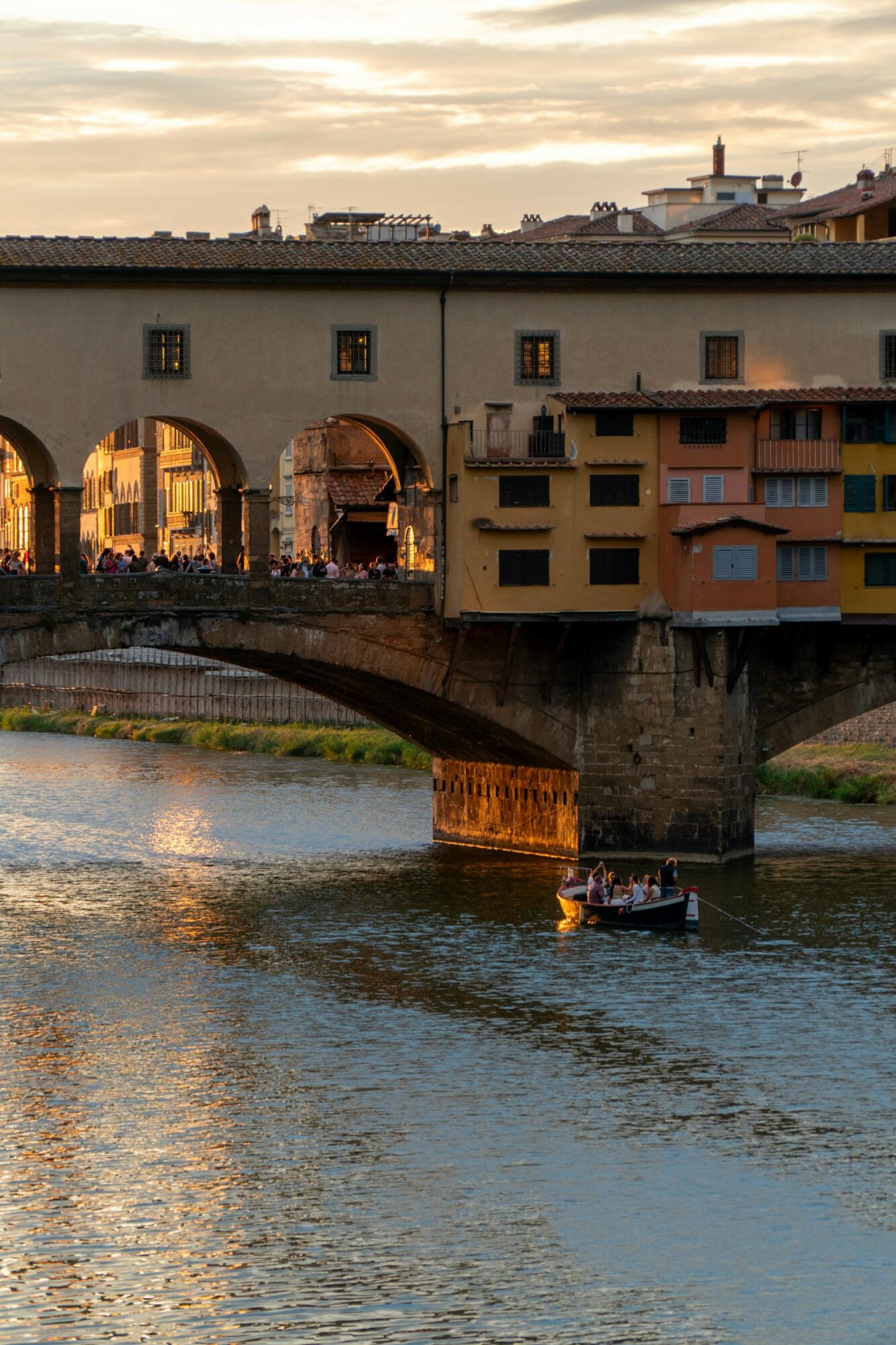
The route runs over the Arno and along Ponte Vecchio, continues towards Palazzo Pitti and comes out through the Boboli Gardens at the Rondò di Bacco gate, in Piazza Pitti.
One way. You do not come back, and you cannot return through the corridor.
Plan the evening around that. Dinner in Oltrarno or around Santo Spirito works. A table booked for eight-thirty beside Piazza della Signoria does not.
Thirty-five minutes, and you keep moving
The regulations describe a managed route of roughly a kilometre, plus another hundred metres between the Buontalenti Grotto and the Piazza Pitti exit. The Uffizi puts the visit at about 35 minutes, and you cannot hang back or stop on your own.
The historic corridor itself is about 750 metres. The difference between that and the kilometre is the approach and the exit, which are part of the walk but not part of Vasari’s architecture.
For planning purposes the 35 minutes is the figure that matters, and then add the ticket check, the group forming up and the walk out into Piazza Pitti. Call it an hour from meeting point to street.
The staff with you are not guides
Gallery staff accompany every group, for security and for the running of the visit. The Uffizi states plainly that they are not tour guides.
So nobody is going to explain the Medici, or Vasari, or why the corridor bends where it bends. If you turn up expecting a narrated tour you will spend 35 minutes walking through a beautiful empty passage wondering what you are looking at.
Licensed private guides can come along with the right booking, working within the group and safety rules.
Otherwise read something first. Twenty minutes of reading before you arrive changes this visit more than any other preparation you could do, because the corridor gives you almost nothing on the walls and everything in the structure.
It was built so the Medici did not have to use the street
Vasari designed it in 1565 for Cosimo I. It let the family move between the government complex around Palazzo Vecchio and their house at Palazzo Pitti without descending into the city.
Political infrastructure first; museum attraction three centuries later. The windows, the turns, the height above the shops: all of it is about seeing without being seen, and about a court that had reasons not to walk among its citizens.
It closed in 2016 for structural, conservation and safety work and reopened in December 2024, eight years later, after a restoration reported at ten to eleven million euro.
The self-portraits are gone
For decades the corridor was known for the long run of artists’ self-portraits along its walls.
Most of those have been moved into museum rooms inside the Uffizi. What reopened is an architectural passage rather than a picture gallery.
Anyone arriving expecting hundreds of paintings will find it bare, and some do. The emptiness is deliberate, and it is closer to what the corridor was for.
What is left is the thing itself: the architecture, the strange privilege of moving above a city, the Arno appearing and disappearing through the windows, and the physical fact of a private road joining two palaces.
No cloakroom, so leave the bag
The evening rules exclude suitcases, backpacks, rucksacks, large umbrellas and anything bulky. There is no cloakroom on these visits.
Turn up with a prohibited item and you can be refused, without a refund. Small umbrellas are fine if they fit in a pocket or a handbag.
This rules out the corridor as the last thing before a train or a flight. Bags go back to the hotel first, or into left luggage, before you get anywhere near the meeting point.
Tickets are personal, named and non-transferable, completed bookings cannot be changed, and no single transaction can hold more than five tickets even across different dates.
Photographs yes, video no
Personal photography is allowed as long as the equipment is not professional. Video is not allowed anywhere in the corridor.
The distinction matters more than it sounds. The views come through windows, in a group that keeps moving, and there is no stopping to set anything up.
A phone is the right tool here. The corridor pays attention back rather than production.
Access has real limits
The corridor takes a visitor’s own wheelchair or walker up to a combined 230 kilograms and 120 centimetres in length. Courtesy wheelchairs and walkers are available on request while they last.
If the lifting platform is out of service and access becomes impossible, the Uffizi says the ticket is refunded.
Anyone with a specific mobility requirement should call before buying. A one-way route with a fixed group pace leaves far less room to improvise than an ordinary museum.
How to use the Friday opening
- Book the Uffizi separately. Earlier the same day, or another day entirely.
- Buy the corridor in advance. 24 euro holds the slot; the 20 euro same-day depends on what is left.
- Leave the luggage. There is no evening cloakroom and no exceptions.
- Read first. Nobody in the corridor is going to explain it to you.
- Book dinner in Oltrarno. You come out in Piazza Pitti, a long way from where you started.
- Give it an hour. Thirty-five minutes is the walk, not the evening.
Luxury.it perspective
The Friday opening is worth having because it lets the corridor be architecture instead of the last item on a crowded museum day.
Twenty-four euro is not nothing for a supervised 35-minute walk, and the price is easier to judge once you know what is not in it. No Uffizi. No guide. No self-portraits.
What is in it is a piece of Medici engineering carried over Florence and opened for four hours a week, after the city has finished being a museum and gone back to being a city.
Related guides
Continue with the guide to luxury hotels in Tuscany and the opening report on Borgo Pignano Florence. If the trip carries on past Florence, Holiday.it has a piece on crossing Tuscany without a car.
For Florence hotels, licensed private guides, museum planning and restaurant reservations, contact Luxury.it Concierge.