Italy has enough lists of expensive hotels.
Those are easy to write and usually not very useful. Put Lake Como, Venice, Florence, Rome, Positano, Taormina and a few countryside estates together, add the word “iconic”, and the ranking almost writes itself. The problem is that price and fame do not tell you whether a hotel is truly rare.
A hotel can be expensive and transferable. It can be beautiful and still feel as if the same experience could be rebuilt somewhere else with enough marble, staff and money. Italy’s best hotels are different. They are not merely well operated. They are inseparable from their site, history, architecture, light, landscape, ritual or cultural capital.
This ranking is based on one question: which Italian hotels would lose their reason to exist if moved elsewhere? The result is not a list of the most expensive hotels in Italy, nor the most photographed. It is a list of the most irreplaceable.
For external reality checks, the 2025 World’s 50 Best Hotels placed Passalacqua at no. 4 globally and named it both Best Hotel in Europe and Best Boutique Hotel, while Four Seasons Hotel Firenze ranked no. 9, Bvlgari Hotel Roma no. 22 and Hotel Il Pellicano no. 26. The Michelin Keys also provide useful confirmation, with the 2025 Italy selection recognising the country’s top hotels across one, two and three key levels.
The method
The Luxury.it Irreplaceability Index gives 30 points to service and consistency, 25 to the asset no competitor can simply buy, 15 to architecture and rooms, 15 to gastronomy and wellness, 10 to privacy and sense of place, and 5 to independent recognition.
The grades are simple. S+ means you travel to Italy for the hotel itself. S means world-class excellence with a non-replicable identity. A+ means an elite hotel with at least one genuinely irreplaceable feature.
The rule is simple: if the hotel can be moved elsewhere and still make sense, it is not irreplaceable.
The order below runs geographically from north to south. The absolute ranking appears at the end.
1. FORESTIS
Plose, South Tyrol · 93.5/100 · Grade A+ · 10th overall

FORESTIS is not the most complete hotel in this ranking. It is not the deepest historically. It does not have the emotional archive of Il Pellicano or the domestic grandeur of Passalacqua. What it has is coherence.
Set on the Plose above Bressanone, facing the Odle peaks, FORESTIS is one of the most disciplined hotel projects in Italy. The suites, the large windows, the spa, the restaurant amphitheatre and the entire architectural language seem to obey the same principle: the mountain is not decoration. It is the organising force.
Many mountain hotels have a view. FORESTIS behaves like an optical instrument pointed at the Dolomites. That is the feature that qualifies it. You do not simply look at the mountains from the hotel. For a few days, the hotel turns the mountain into the structure of your waking, dining, bathing and resting.
Why it is not higher: the atmosphere and design are exceptional, but compared with the first names on this list, FORESTIS has less historical depth and a less layered emotional inheritance.
2. PASSALACQUA
Moltrasio, Lake Como · 99/100 · Grade S+ · 1st overall

Passalacqua is the best hotel in Italy right now.
Not because it has the largest spa, the most expensive suite or the loudest international mythology. It wins because almost nothing about the experience feels detachable from the place. There are only 24 rooms. The villa is eighteenth-century. The gardens are terraced. The service has the intimacy of a private house rather than the machinery of a large palace. The lake is not a view added to the experience; it is the reason the villa breathes the way it does. The World’s 50 Best Hotels describes Passalacqua as set within terraced gardens with just 24 rooms, and in 2025 placed it at no. 4 globally while naming it Best Hotel in Europe and Best Boutique Hotel.
The detail that makes it irreplaceable is the Bellini Suite. Its centre is a double-height neoclassical music room where Vincenzo Bellini wrote passages of his operas, inspired by the lake. This is not a modern hotel room decorated after the fact with a composer’s name. It is the actual historical room, turned into the centre of the suite. That is the difference between theme and inheritance.
Why it wins: no other Italian hotel combines domestic scale, historical weight, theatrical beauty and contemporary service with this degree of naturalness. At Passalacqua, luxury does not feel arranged for the guest. It feels as if the villa continued living and you were admitted inside.
3. AMAN VENICE
Venice · 96.5/100 · Grade S · 4th overall

Aman Venice is one of the rare cases where Aman’s controlled minimalism does not sterilise an old building.
That could easily have happened. Palazzo Papadopoli, on the Grand Canal, does not need help becoming important. It has frescoes, stucco, fireplaces, chandeliers, Venetian light and the weight of a private palazzo. A lesser hotel brand might have over-decorated it. Aman does the opposite: it lets the building speak.
The real rarity is not only the palazzo. It is also space. Aman Venice has private gardens, a near-impossible luxury in the dense fabric of Venice.
The qualifying detail is the Alcova Tiepolo Suite: 103 square metres with original Tiepolo frescoes, gilded ceilings, a fireplace and a hand-painted Chinese sitting room. Here, you are not sleeping in a room with art on the walls. You are sleeping under part of the palazzo’s artistic inheritance.
Why it is not on the podium: the building is almost unbeatable, but the Aman experience can be intentionally rarefied. Passalacqua and Four Seasons Firenze have a warmer human immediacy.
4. CASA MARIA LUIGIA
Modena, Emilia-Romagna · 94/100 · Grade A+ · 9th overall

Casa Maria Luigia is not a conventional luxury hotel. That is why it belongs here.
Massimo Bottura and Lara Gilmore took an eighteenth-century country house outside Modena and turned it into a private extension of their world: contemporary art, vinyl, books, Italian cars, motorcycles, Emilian produce and the cultural universe that grew out of Osteria Francescana.
The hotel’s irreplaceability is gastronomic and cultural. Francescana at Maria Luigia serves, at communal tables and in front of an open kitchen, a nine-course menu composed of some of the most important dishes once served at Osteria Francescana: Five Ages of Parmigiano Reggiano, The Crunchy Part of the Lasagna, Oops! I Dropped the Lemon Tart and other chapters of Bottura’s culinary history.
This is not simply a hotel with a great restaurant. It is a living archive of contemporary Italian cuisine where you can sleep.
Why it is not higher: it is less complete as a grand hotel machine. It enters the top ten not because it has the widest service universe, but because no other hotel can replicate its cultural and gastronomic capital.
5. FOUR SEASONS HOTEL FIRENZE
Florence · 97/100 · Grade S · 3rd overall

Four Seasons Hotel Firenze is one of the few Italian urban hotels that functions simultaneously as palace, resort and refuge.
It occupies a fifteenth-century Medici palazzo and part of a former convent, set inside the largest private garden in Florence. That combination gives it a rare advantage: you can be in the heart of the city and, for hours at a time, forget the city is beyond the gate.
The 2025 World’s 50 Best Hotels ranked Four Seasons Hotel Firenze no. 9 globally, and Four Seasons itself notes that the hotel has appeared in the ranking every year since the list began.
The qualifying detail is hidden and almost absurdly Florentine: a private dinner for two can be arranged in the palazzo’s small chapel, surrounded by original fifteenth-century frescoes. Not a Renaissance-inspired event room. A chapel inside the estate.
Why it is on the podium: many city hotels make you choose between historical monument and international service. Here you get both, plus the feeling of a resort. Florence remains outside, but the hotel has its own weather.
6. RESCHIO
Lisciano Niccone, Umbria · 95.5/100 · Grade S · 6th overall

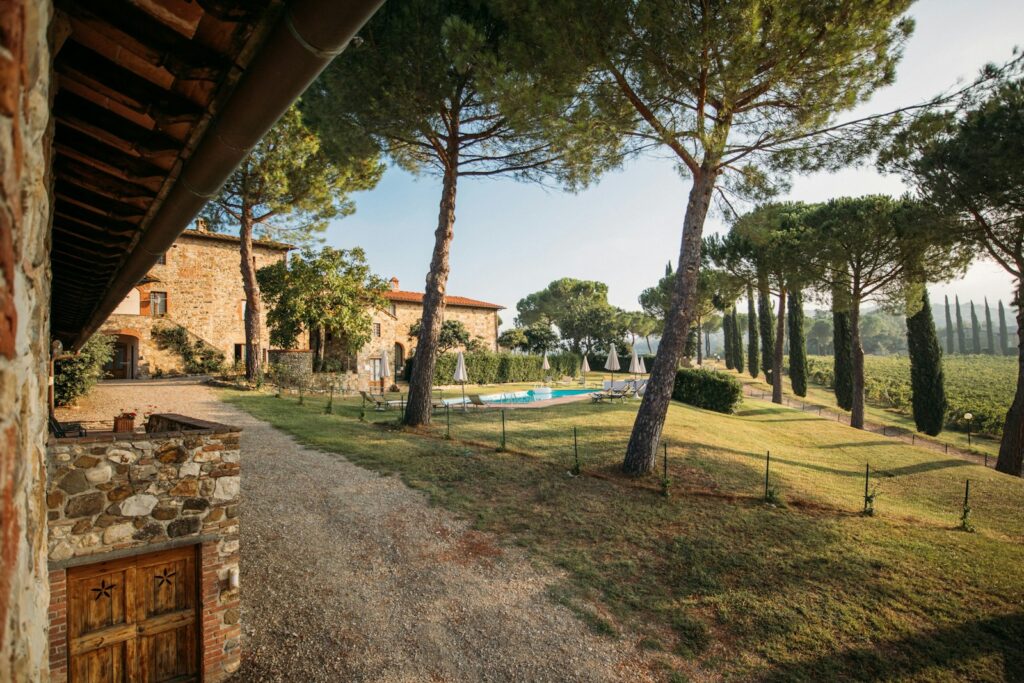
Reschio is not a hotel with land around it. It is a private world.
The estate covers around 3,700 acres, built around a thousand-year-old castle and more than fifty restored farmhouses, recovered over decades by the Bolza family. Architecture, furniture, horses, landscape, food, silence and domestic ritual all belong to the same ecosystem.
Its most theatrical detail is the Bathhouse, created inside the castle’s old wine cellars. The Roman bath sits beneath vaulted rooms; a private room holds a fireplace, loungers, opposing tubs and an old stone grotto once used to store ice.
But the greater rarity is scale. You can ride for hours through a private Umbrian world and return to the castle having barely met the present. That is not a service. It is territorial authorship.
Why it enters: Reschio may be Italy’s best example of territorial luxury. It does not show Umbria to the guest. It creates a private, self-contained version of Umbria.
7. HOTEL IL PELLICANO
Porto Ercole, Tuscany · 94.5/100 · Grade A+ · 8th overall

Il Pellicano began in 1965 as a love story and a private club hidden in a cove on the Argentario. Sixty years later, it still has what money cannot buy quickly: habit.
The heated seawater pool, terraced private beach, cottages in the vegetation, white-and-yellow beach club, lunch rhythm, aperitivo hour and social memory of fashion, cinema and photography create a cultural atmosphere that does not feel assembled for guests. The guests are part of the atmosphere.
The World’s 50 Best Hotels placed Il Pellicano at no. 26 in the 2025 list, confirming what regulars have known for decades: this is not just a pretty hotel by the sea.
Its irreplaceable feature is not one suite. It is the immaterial capital of the beach club. Many hotels can build a beautiful pool on the sea. None can retroactively purchase sixty years of families, photographs, lunches, relationships and quiet social continuity.
Why it is not higher: some rooms and parts of the experience are intentionally less spectacular than its competitors. Il Pellicano wins by soul, not by quantity of marble.
8. BVLGARI HOTEL ROMA
Rome · 95/100 · Grade S · 7th overall

Bvlgari Hotel Roma is the best new large urban hotel in Italy.
That is not a small statement. Rome has seen an extraordinary hotel wave, but Bvlgari solved something many branded hotels get wrong: it feels specifically Roman rather than simply expensive in Rome.
The hotel occupies a Rationalist building facing the Mausoleum of Augustus and the Ara Pacis. It has 106 rooms, a 1,500-square-metre spa inspired by Roman baths and a 20-metre indoor pool. The World’s 50 Best Hotels ranked Bvlgari Hotel Roma no. 22 in 2025.
The qualifying detail is the Bvlgari Suite. It looks directly toward the Mausoleum of Augustus. Not a generic Roman panorama with distant domes. The most important dynastic tomb of ancient Rome becomes the suite’s daily architectural presence.
Why it enters: jewellery, marble, geometry, spa culture and archaeology combine into an identity that belongs to Rome. It does not feel like an international format merely placed in the capital. Why it is only seventh: the technical excellence is extremely high, but the hotel’s emotional history is still young compared with Passalacqua, Il Pellicano or Il San Pietro.
9. IL SAN PIETRO DI POSITANO
Positano, Campania · 98.5/100 · Grade S+ · 2nd overall

Il San Pietro is the only hotel that can seriously challenge Passalacqua for first place.
It was imagined by Carlino Cinque and built into a promontory outside Positano. That word, “into”, is important. The hotel is not placed on the cliff. It is composed through cliff, terrace, room, garden, rock and sea. The rooms have private terraces, but the real architecture continues below the visible hotel.
The qualifying detail is one of the most physically irreplaceable hotel experiences in Italy: an elevator carved through the mountain descends directly to the private beach and to the restaurant Carlino. At sea level there is also a regulation tennis court squeezed between the rock wall and the coast.
Here, the mountain is not scenery. It is corridor, foundation, wall, infrastructure and part of the emotional engineering of the stay.
Why it is second: in position and physical drama, Il San Pietro could be number one. Passalacqua wins by a fraction because its 24-room intimacy and continuity between villa, interiors, garden and service are more uniformly resolved.
10. SAN DOMENICO PALACE
Taormina, Sicily · 96/100 · Grade S · 5th overall

San Domenico Palace is a fourteenth-century convent turned hotel on a rocky promontory above the Ionian Sea.
The building still has cloisters, courtyards, gardens and monastic perspectives. Today it also has Four Seasons service, a cliffside infinity pool and Michelin-recognised hospitality. Four Seasons describes San Domenico Palace as recognised with Three Michelin Keys, the highest Michelin hotel distinction.
Its irreplaceable feature is the coexistence of medieval cloister, Ionian light and Etna. Within a few steps, the guest moves from inward monastic silence to the total opening of the sea.
This is not a historic building used as scenery. The monastery still determines how you move, pause and observe the landscape.
Why it enters: it may be Italy’s strongest historic resort for contrast. Austerity and sensuality. Cloister and sea. Monastery and Sicily.
The absolute ranking
1. Passalacqua, 99/100
2. Il San Pietro di Positano, 98.5/100
3. Four Seasons Hotel Firenze, 97/100
4. Aman Venice, 96.5/100
5. San Domenico Palace, 96/100
6. Reschio, 95.5/100
7. Bvlgari Hotel Roma, 95/100
8. Hotel Il Pellicano, 94.5/100
9. Casa Maria Luigia, 94/100
10. FORESTIS, 93.5/100
Luxury.it perspective
The best hotel in Italy is Passalacqua. Not because it has the biggest spa, the highest room rate or the most heavily photographed restaurant. It wins because almost no part of the experience feels separated from the place. The room count, villa, lake, music history, gardens and service all seem to belong to the same story.
The most astonishing single feature, however, belongs to Il San Pietro di Positano: descending to the sea through the mountain by elevator, arriving at a private beach, a restaurant and a tennis court carved into the cliffside remains the most physically irreplaceable hotel experience in Italy.
No regional quotas were imposed. Sardinia, Puglia and Capri have exceptional hotels, but in an absolute list of ten, geography cannot guarantee entry. The rule stands: if the hotel can be moved elsewhere and still make sense, it is not irreplaceable.
Related guides
Luxury Hotels on Lake Como · Michelin Star Restaurants in Italy · Luxury Hotels on the Amalfi Coast · Destinations
Planning Italy around the hotels that cannot exist anywhere else? Request access through Luxury.it Concierge.