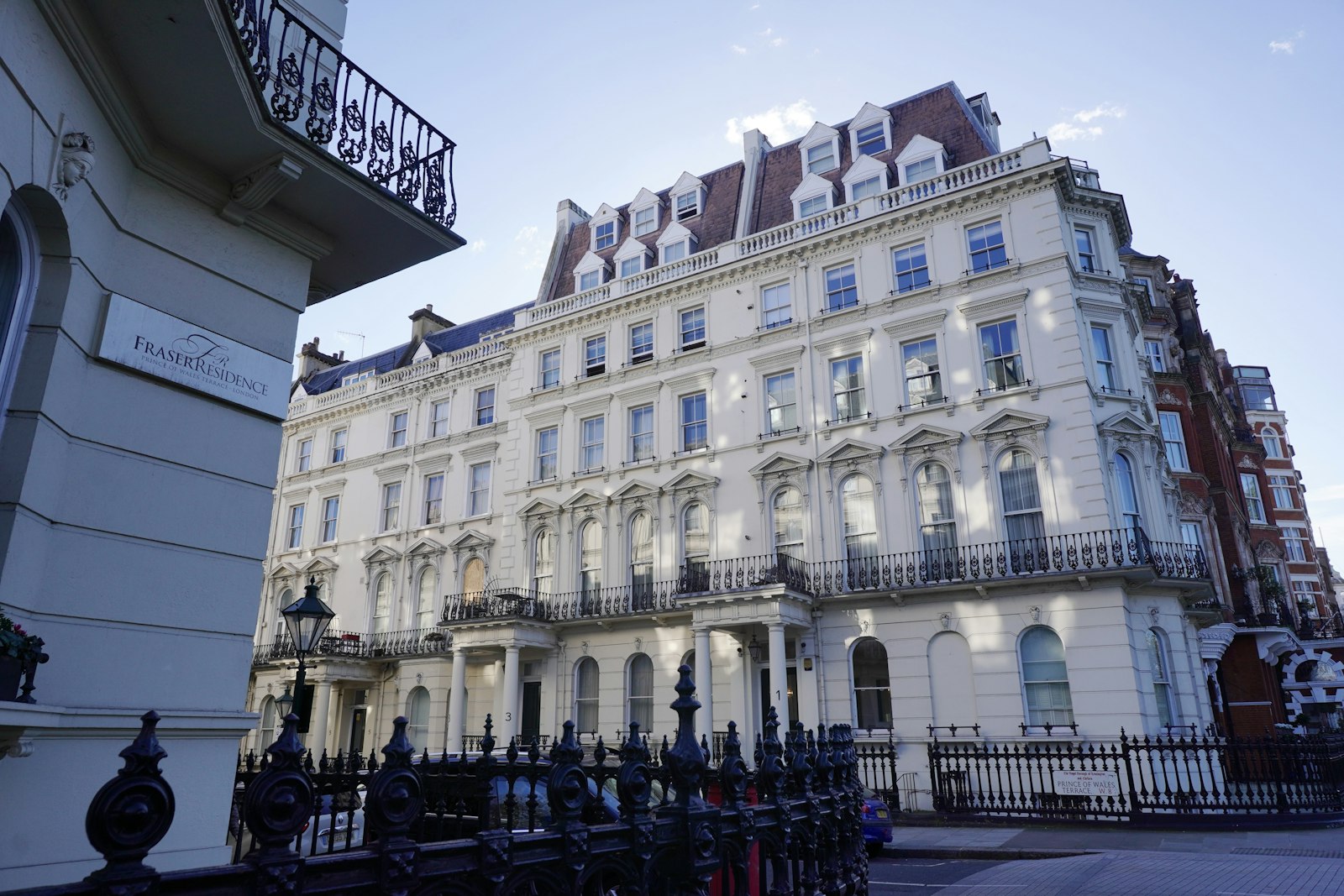
Prime central London has recorded its first quarterly price rise in four years, Knight Frank said on Friday 2 October. Prices rose 0.3 per cent in the three months to September, and over the year they were down 2 per cent, the smallest annual fall in 18 months. At the top of the market, 121 homes sold for more than £10 million in the year to September, as many as in the previous year, and the total spent on them rose 14 per cent to £2.4 billion. A rise of 0.3 per cent is small. But average prices in prime central London are still 22 per cent below their last peak, in August 2015, according to the same note, and in a market that has waited four years for a quarter like this, the direction matters more than the size.
0.3 per cent, 121 sales and £2.4 billion
The note is by Tom Bill, Knight Frank’s head of UK residential research, and its central line is plain: September brought “the first period of quarterly price growth (+0.3%) in prime central London for four years”, as the research note puts it. The index stood at 5,004.4. Prime outer London, which Knight Frank describes as the more domestic and needs-driven market, fell 0.6 per cent over the year, and values there have not moved by more than 1 per cent in either direction since May 2025. Transactions steadied too. Exchanges across prime central and prime outer London were 2.5 per cent lower in the year to September than in the previous 12 months, against a fall of 14 per cent in March. The super-prime market above £10 million followed the same pattern. Its low point came in the 12 months to November 2025, with 106 sales, down from 155 a year earlier, and it has since climbed back to 121. “While the super-prime market hasn’t rebounded to 2024 levels, it has stabilised,” the note says. Mortgage rates fell towards 3.5 per cent at the start of the year, rose closer to 4.5 per cent in March and rose again in mid-September.
Sellers who listen, buyers who rent
The change comes from both sides of the table. Liza-Jane Kelly, head of London sales at Knight Frank, starts with the sellers. “We are starting to see sellers become more realistic with their price,” she said. “Some have been on the market for several years and want to get on with their lives.” The buyers are a different story. Some of them have been renting while they waited, and Knight Frank’s rental figures for September, published the same day, show the pressure. In prime central London, rents rose 1.3 per cent over the year and 1.8 per cent over the last six months, the fastest half-year since January 2024, and there were 5.6 new prospective tenants for every new property, the highest ratio in four years. In prime outer London, rents rose 3 per cent, with 8.9 tenants for every new home to let. Some owners chose to let. According to Knight Frank, the weakness of sales in prime central London led more owners who did not need to sell to rent out their homes instead. Kelly’s conclusion is the line of the quarter.
“Meanwhile buyers, some of whom have been renting, are sensing value after the price declines of the last decade. What this year has clearly shown is that underlying demand strengthens quickly when the negative news fades.” Liza-Jane Kelly, head of London sales, Knight Frank, 2 October 2026.
Mayfair, Belgravia and 13 more areas
Prime central London is a defined territory. Knight Frank’s London map of June 2026 groups 15 areas under it: Aldgate, Belgravia, Chelsea, Hyde Park, Islington, Kensington, King’s Cross, Knightsbridge, Marylebone, Mayfair, Notting Hill, Riverside, South Kensington, St John’s Wood and Tower Bridge. The index behind the headline was established in 1976. It is based on repeat valuations of existing homes and leaves out new-build, while the super-prime figures count every sale above £10 million across the market. The long view explains the mood. In the 12 months to November 2014, £4.2 billion was spent on 225 homes above £10 million; in the 12 months to November 2023, 175 sales made an eight-year high; the low point came two years later. Where those sales happen has moved, too. In the last breakdown Knight Frank published, for the year to July 2024, Kensington took 21 per cent of super-prime deals, with Notting Hill, Mayfair and Knightsbridge at 13 per cent each, and seven sales in ten were houses. The 2 October note gives no split by area for the 121 sales, and no figure for September alone.
London and Europe’s prime cities
London’s turn comes later than most of Europe’s. In Knight Frank’s Prime Global Cities Index for the second quarter of 2026, which tracks 47 cities, London was down 3.6 per cent over 12 months, 41st of 47. Vienna rose 5.9 per cent, Lisbon 4.5, Geneva 4.4, Zurich 4.3 and Madrid 3.7; Monaco was up 1.6 per cent and Paris 1.3, while Milan fell 2.4. Those figures cover a different period and basket from the London index. They show direction. At the very top, London kept its weight: in the second quarter, 44 sales above US$10 million, worth US$1.43 billion, made it third in the world by value. On the Continent, the word in Knight Frank’s research is scarcity. Its data show prime transactions in Italy up 140 per cent year on year in the eight months to August, and in Milan, “where international buyers dominate at the top end”, homes that meet wealthy buyers’ expectations are short. We followed that market in our guide to Italy’s most expensive homes for sale and in our guide to branded residences in Italy.
Why the turn came in September
Knight Frank’s explanation is short. “This year has proved the theory that the mere absence of bad news fuels demand in the residential property market,” Tom Bill writes. Two things changed on the ground. Sellers who had held out for old prices began to negotiate, some after years on the market. And buyers who had been renting began to see value in prices 22 per cent below the 2015 peak, at a time when, in the words of Stuart Bailey, Knight Frank’s head of prime central London sales, in August, “Exceptional properties are in short supply”. His full sentence explains the rest: buyers who once refused refurbishment projects are now taking them on to get what they want. One quarter is not a trend. Mortgage costs rose again in mid-September, the note records, and the next three months will show whether the turn holds. But for the first time in four years the index has moved up, and in a market where every sale above £10 million is counted, buyers watch the direction.
The Luxury.it perspective
The interesting word in Knight Frank’s note is realistic. For four years prime London has been a market of owners waiting for yesterday’s prices and buyers waiting for tomorrow’s, and a quarter of 0.3 per cent is the first sign that the two have started to meet. The rental figures show where the demand went. It moved into rented homes, and some of it, in Kelly’s words, is now sensing value. For a buyer, the lesson of the year is in Stuart Bailey’s line on scarcity: the exceptional houses are few, and the right address is worth a renovation. For a seller, Kelly’s word is the advice. A realistic price is the one that sells, and in September, for the first time in four years, prices rose.
Related guides
Cambridge House on Piccadilly · Dukes London reopens in 2027 · Villa d’Este’s private villas · Luxury villas on Lake Como