Lionard is selling Villa Pieds Dans L’Eau, on the island of Cavallo, for 18 million euros. The house has 700 square metres on a single level, twelve bedrooms and twelve bathrooms, a guest house and a private dock, in a coastal park of 4,700 square metres that runs down to a white-sand beach and a cove. Its central staircase is carved into a granite monolith, and the building is almost invisible from the sea. It is a broker’s listing, and no owner is named. But it opens the door of one of the organic houses the architect Savin Couëlle built in the 1970s, as Wallpaper reported on Tuesday 6 October, on an island of 120 hectares in the strait between Corsica and Sardinia.
700 sq m around a granite monolith
The plan is unusual. According to the Lionard listing, “The 700 sqm interior unfolds on a single level around an ancient granite monolith, whose central staircase, carved directly into the rock, forms the backbone of the entire structure.” The reception rooms include a sitting room with a fireplace, dining rooms and a large professional kitchen. The sleeping area is made of private suites with their own bathrooms, and the broker also mentions bedrooms for staff. Large windows, shaped to measure, open onto covered verandas and dining areas shaded by wooden structures. The materials are local stone, white lime plaster and vaulted ceilings, with granite emerging inside the rooms, and every opening, in the listing’s words, frames “the turquoise waters of the archipelago”. The price works out at about 25,700 euros per square metre of interior, before the land and the guest house are counted. The listing gives no year of construction beyond the decade, no energy class and no listing date.
A dock, a cove and 4,700 sq m of maquis
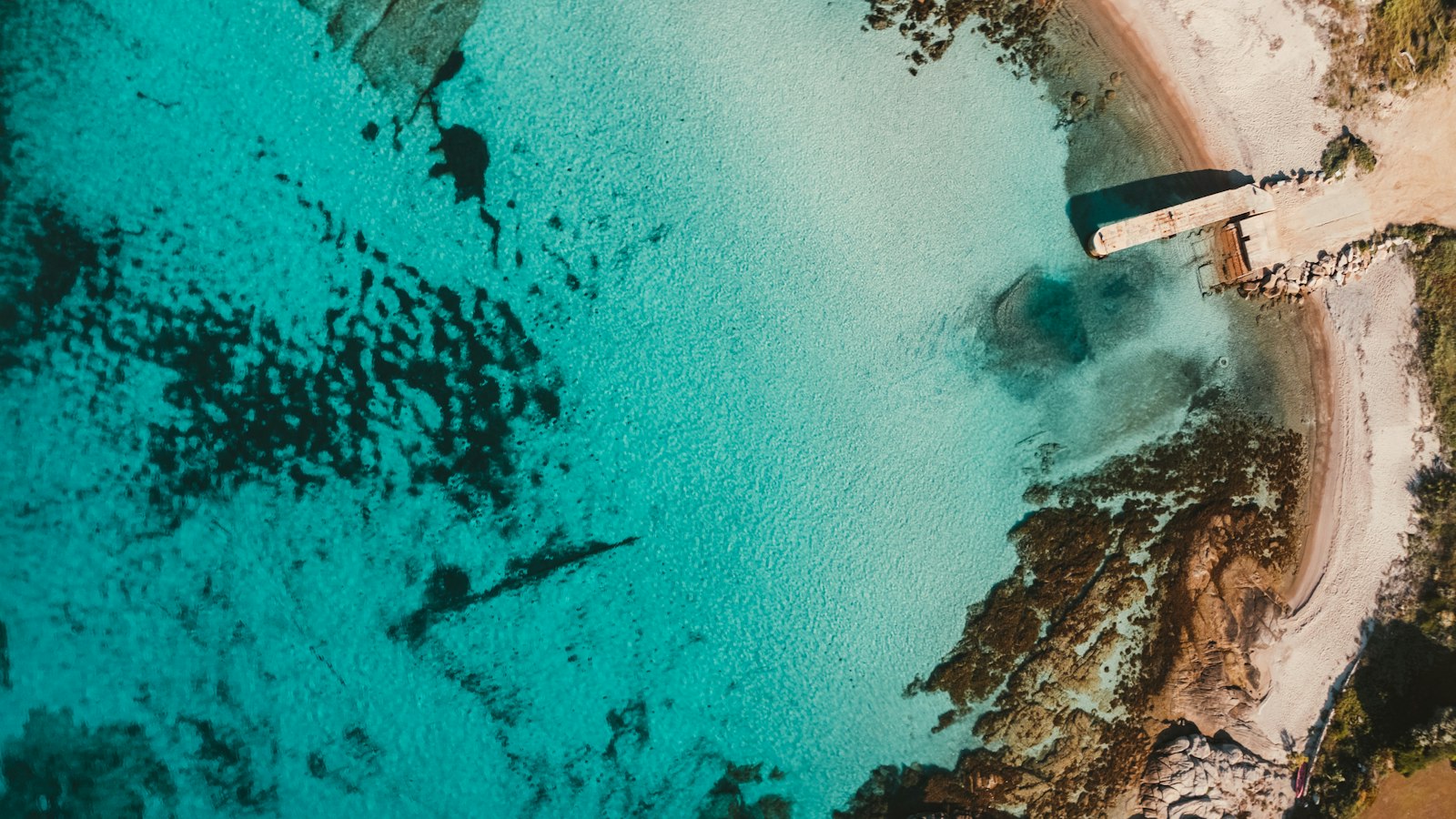
The outside is the point. The estate extends across 4,700 square metres of private land, where lawn, Mediterranean scrub and granite cliffs slope down to a private cove of fine sand, and the park also takes in a white-sand beach. A private dock with a mooring point allows boats to berth directly, for trips along the Strait of Bonifacio. An independent guest house can take guests or caretakers, and several lounge areas are sheltered from the prevailing winds. No pool is mentioned. Wallpaper, which published the house on 6 October, described how it meets the rocks. Couëlle integrated the villa directly into the coastline, the magazine wrote, incorporating granite outcrops, with curved roofs and cave-like openings to frame the sea.
“In keeping with Cavallo’s rules, the house is almost completely invisible from the sea, with monumental masonry carefully spliced between the existing granite rocks.” Jonathan Bell, Wallpaper, 6 October 2026.
Savin Couëlle, son of the Cala di Volpe architect
The name explains the interest. Savin Couëlle, who lived from 1929 to 2020 according to Wallpaper, was the son of Jacques Couëlle, the architect of the Hotel Cala di Volpe on the Costa Smeralda, built from 1961 to 1963, according to the Italian Ministry of Culture’s atlas of contemporary architecture. The same record recalls that Jacques Prévert called the father “the anarchitect”. France’s Ministry of Culture counts Jacques Couëlle among the principal figures of “l’architecture sculpture”, and the hamlet of Castellaras-le-Neuf, which he designed at Mouans-Sartoux in the Alpes-Maritimes, carries the national label for remarkable contemporary architecture. Father and son, Domus has written, conceived an organic architecture of forms almost shaped by the wind. Savin’s own works on the Costa Smeralda include the villa Nido d’Uccello on the hill of Porto Cervo, one of his first, according to Domus. On Cavallo, Wallpaper writes, he worked under strict building codes, with a height limit of 4.5 metres and planting that screened new buildings from the sea, and the house took four years to build in the 1970s.
Cavallo, 120 hectares in the Lavezzi
The island is small. Cavallo, or Cavallu in Corsican, covers 120 hectares in the Lavezzi archipelago, according to Corsica’s regional atlas, the Atlas des Paysages; its granite is the same that underlies Corsica and Sardinia. Bonifacio’s tourist office notes that it is the only inhabited island of the group, and the atlas records its marina and a landing strip for light aircraft. The Lavezzi are 30 minutes by boat from Bonifacio. The waters around them belong to the Réserve naturelle des Bouches de Bonifacio, created in 1999 and the largest nature reserve in metropolitan France, and since 2012 to the International Marine Park of the Strait of Bonifacio, run with the Maddalena National Park. The decree that created the reserve leaves the land of Cavallo outside it. To the south-east lie the Maddalena islands, and beyond them the coast we cover in our guide to the Costa Smeralda, where Cheval Blanc is preparing the Pitrizza for 2027.
Why a Couëlle, and why now
Two things give the listing weight. The first is the architecture. The Couëlle name belongs to the history of the Costa Smeralda, and this house carries it across the strait to Cavallo. The second is the moment. Knight Frank wrote on 25 September that prime residential transactions in Italy rose 140 per cent year on year in the eight months to August, and that its forward pipeline extends into Sardinia and Lake Como. Across the strait, Engel and Völkers’ Market Report Italia 2026, produced with Nomisma, puts top prices for villas, penthouses and seafront homes on the Costa Smeralda at up to 35,000 euros per square metre, according to idealista. Lionard itself was founded in Florence in 2008 and opened an office in Porto Cervo in 2023, which puts Cavallo within reach of its Sardinian office.
The Luxury.it perspective
The word to keep from this listing is concealed. Lionard writes that the house is “completely concealed from the view of passing boats”, and that is the whole Couëlle idea: a villa that belongs to the rock rather than to the view of it. A house designed to be invisible from the sea is a different kind of luxury: the view belongs to the owner, and the coast keeps its outline. For a buyer, the practical questions are the island’s: how one arrives, by sea from Bonifacio or by light aircraft, and what its rules allow, with a height limit that already shaped the house fifty years ago. Anyone who knows Cala di Volpe will recognise the family hand.
Related guides
The most expensive homes for sale in Italy · Branded residences in Italy · The best hotels on the Costa Smeralda · Luxury villa rental in Italy